
Grape Money & Ghost Protocols
How I learned to stop worrying and love the micropayment
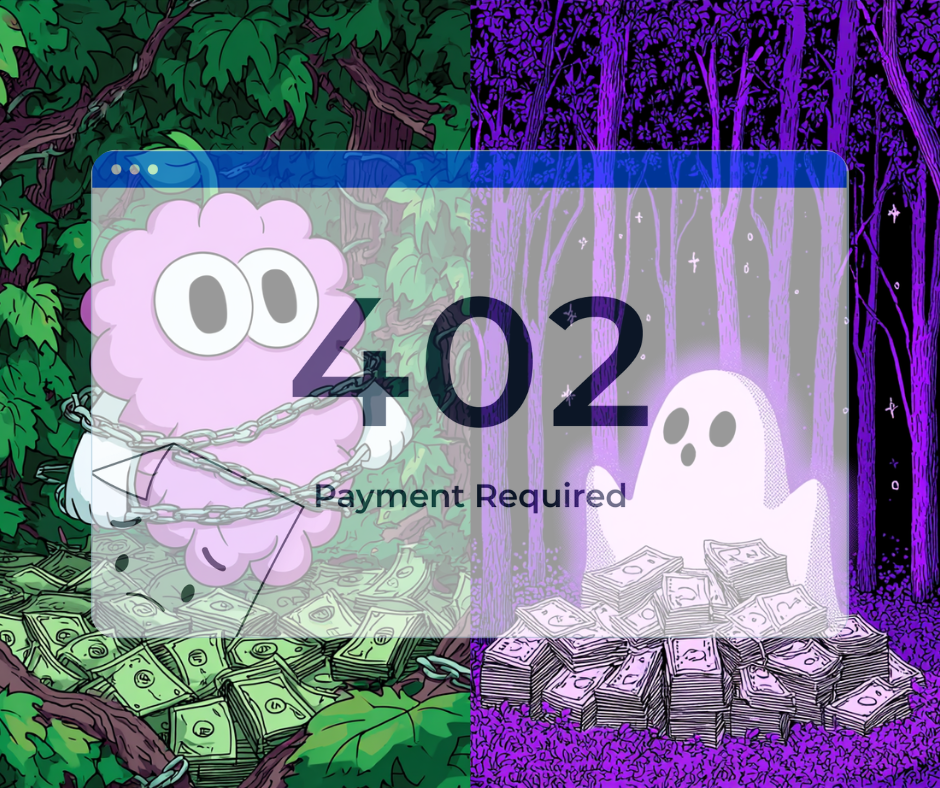
The internet has always struggled to price its own activity, for its flaw was economic. Every packet and request represents discrete computation — in theory something we could assign value (and thus a price) to — but the web had no native mechanism to do so. Traditional rails imposed fixed costs that overwhelmed small transactions: a penny transfer might cost fifty cents to process.
For what it’s worth, this was true in the early days of crypto, too! Banks and institutions like VISA and Mastercard tried sending single digit dollars on Ethereum and gas costs alone were in the $100s. The classic academic example is trying to buy a single grape with a credit card at a farmers market. In theory it’s possible, and with physical money it might work, but with modern digital money it’s absurd. It’s even more ridiculous given that in theory digital value should be infinitely divisible into extremely small units.
This limit forced the internet into uncomfortable compromises including monthly subscriptions around sporadic usage, advertising and surveillance capitalism, or gate access behind complex identity systems. The unused HTTP status code 402 (”Payment Required”) became a monument to unrealized potential, reserved for an ideal internet couple with an economy that never materialized. For thirty years, it sat there like a placeholder for dreams deferred.
Our probabilistic nanopayments was a serious attempt to solve this problem. Rather than fighting the economics of micropayments, we reengineered them mathematically, using the Law of Large Numbers as a payment settlement mechanism.
Instead of sending a small amount of value per packet (the proverbial “single grape at a market”), Orchid clients issued cryptographic claims on an expected statistical value. Most claims paid nothing, but a few paid the full face value. In time and over thousands of interactions, the mathematics guaranteed convergence to the intended payment amount.
As one of our core contributors Dr. Chloe Avery formalized in her foundational paper: “Small-scale randomness aggregates into large-scale predictability, permitting new forms of economic coordination previously impossible due to transaction friction.”
In short, the system treated randomness itself as economic infrastructure, a particularly elegant solution given that randomness is essentially free to generate but mathematically valuable to guarantee.
The transaction — in classic crypto fashion — was trust minimized, too. Sender and receiver contributed random inputs that, when hashed together cryptographically, determined the outcome. Neither party could manipulate results, no payment processor extracted fees, and no settlement delay interrupted service. We demonstrated that the smallest unit of economic value could be made trustless and efficient with math, removing the need for intermediaries (which are the primary reason for increased transaction costs). For bandwidth providers, this meant predictable revenue streams without per-packet settlement costs. For clients, it enabled granular, pay-as-you-consume access without subscriptions or accounts.
But our architecture was intentionally constrained: it solved micropayments within the specific domain of network bandwidth. Clients paid for packets and providers received compensation for relay services.
The emerging x402 standard is more ambitious. Named after the dormant HTTP status code, x402 proposes embedding payment logic directly into web protocols.
Where Orchid demonstrated that trustless micropayments could operate at scale, x402 defines how they can extend across the entire web. In x402’s model, any endpoint that adopts the standard (an API, inference engine, database, or service) can specify a payment requirement and price its resources on demand. Each transaction settles through modern crypto rails:
Stablecoins for predictable denomination
L2 networks for sub-second confirmation
Onchain finality that eliminates chargebacks
What we achieved with probabilistic mathematics within a bounded network, x402 expresses as a general protocol for machine-native payments, turning web requests themselves into economic primitives.
The distinction between these systems makes clear a broader evolution in how digital economies operate and how the web will work in the (perhaps near) future. Orchid relied on statistics, specifically the Law of Large Numbers. Our nanopayments existed in the space of probability, where cryptoeconomic guarantees minimized the need for traditional trust mechanisms. x402 operates in protocol space, where deterministic rules govern machine-to-machine interactions. It embeds economic logic into the web’s existing request-response architecture, making payments as native as content delivery.
The shift is a sign of maturing infrastructure: what once required elegant mathematical workarounds now functions with direct protocol support. Both approaches reject the fundamental assumption that online payments need to be large, infrequent, and mediated by established institutions. (As an aside, this may also mirror the emerging obsolescence of traditional certifications. The movement behind “just doing things,” or building out a github, or writing about a topic with clarity…)
All of this will become important (obviously) as agents emerge as economic participants. An autonomous system that consumes thousands of API calls, model inferences, and data sources per minute will have difficulty operating with traditional payment methods (not to mention a UX that’s designed for humans). It needs systems that price things atomically, settle instantly, and don’t require humans (sorry). Imagine agents trying to navigate the modern web’s payment systems: filling out forms, entering credit card numbers, solving CAPTCHAs to prove it’s hum… on second thought, maybe don’t.
Although we didn’t quite have the infrastructure, our nanopayments anticipated this! The idea that individual uncertainty aggregates into collective predictability applies perfectly to agent-driven economies where volume smooths variance. An agent issuing millions of probabilistic payments would experience statistical convergence in real-time. x402 is an even better, more native application of our logic. The same agent might pay per inference from one model, per query from another database, per second of compute from a third provider, all through standardized web protocols rather than custom payment integrations.
Seen from a historical context, both systems represent attempts to restore the internet’s original economic model. The early web’s architects assumed that resources would eventually be priced per request (hence the reservation of status code 402!).
When payment infrastructure failed to materialize, the web adapted with what eventually became surveillance capitalism founded upon advertising. It’s worth remembering that the ad-industrial complex was a workaround that became permanent because alternatives seemed impossible — not some grand design.
x402 and the innovations that will inevitably follow mark the emergence of the web’s native economic layer and the onset of the “Agent Age” or “Agentic Web.”
Orchid’s contribution was demonstrating that trustless, infinitesimal payments could actually work at scale. x402’s contribution is making them standard across the web, machine-readable, and AI-native. The future looks bright!