
Why AI Needs Marketplaces, Not Monopolies
New technology should always reflect diverse human values and preferences, not the commercial interests of a few technology companies.

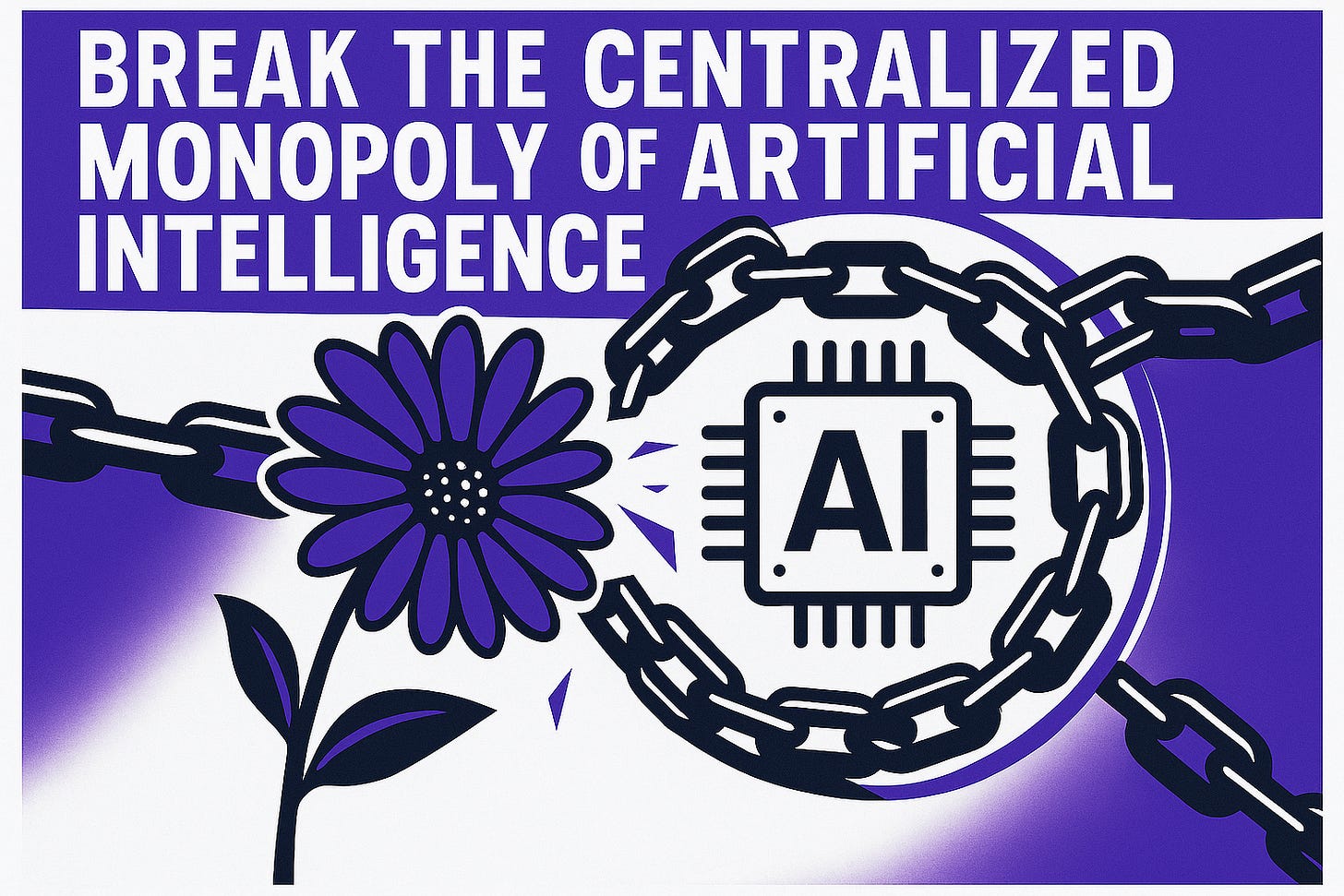
AI is the most transformative technology in history to date, but it still currently resembles past tech revolutions in its market structure. Railroad monopolies, telecom buildouts, the early internet, the list goes on. In short, the pattern is power concentrated in the hands of a few giant central players who exercise disproportionate control over both the infrastructure and the access. Concentration of the kind being demonstrated in AI threatens not just competition, but the fundamental trajectory of human technological development.
Since the advent of the internet, tech revolutions often suffer from what researchers call a “winner take all competition” where massive companies dominate through sheer scale. Nassim taleb argued as much in his recent piece “The World in Which We Live Now,” writing: concentration [is] a distinctive feature of the modern world, often tied to what I called the Black Swan problem. We now see winner-take-all effects everywhere, owing to connectivity.”
One can imagine our current environment where OpenAI partners exclusively with Microsoft, Google controls access to its most advanced models, and Anthropic requires enterprise contracts for full capabilities, for example. Meanwhile, those who do not possess the resources necessary to participate in the oligopoly are excluded.
This centralization creates three critical problems: innovation stagnation, user dependency, and systemic fragility. When a handful of companies control AI development, they optimize for their business models rather than human potential. When users depend on single providers, they lose negotiating power and become subject to arbitrary pricing and policy changes. When critical infrastructure concentrates in a few hands, single points of failure can affect millions of users simultaneously.
We’ve seen it before and we’ll see it again: decentralization and marketplaces are the engine for continued progress. Systems that encourage competition in open markets rather than walled gardens consistently incentivize effort, progress, improvement, and innovation. Coupled with the massive participation permitted by even a modicum of open-source technology, over time decentralized systems will emerge as a necessary and superior alternative to the opaque concentration of early-stage tech booms.
The Marketplace Vision
Orchid’s GenAI platform demonstrates how AI marketplaces can work in practice. It’s designed to create what we call “a decentralized marketplace for AI services” where users can access over 30 different AI models through a single interface.
Instead of subscribing to individual providers, users pay with probabilistic nanopayments that enable real-time, usage-based billing. The system separates payment flows from service delivery, allowing users to mix and match models and tools without vendor lock-in.
Recent implementation details reveal the practical power of this approach. Users can send prompts to Provider A’s language model, which then requests tool calls that get dispatched to Provider B’s services, with results flowing back through the system seamlessly.
As our Lead Developer Dan Montgomery explains, “This is Orchid’s decentralized ethos in action: a marketplace where computing services like inference, tools, and more live on their own terms. Providers compete on quality and rates so users can stitch them together as needed.”
There’s even a feature called “Party Mode,” where users can change models within the same conversation, preserving the chat history and asking different models for their reaction to the context.
Why Marketplaces Drive Innovation
The fundamental advantage of marketplace architectures is something we at Orchid hold dear: incentive structures. Monopolistic platforms optimize for user retention and data extraction – they want users scrolling, clicking, and sharing personal information. This is even more important in the age of what our Founder Dr. Steven Waterhouse calls “Relational Technology,” impacting the way users interact with AI, privacy, and performance. AI marketplaces optimize for utility, meaning users accomplishing their actual goals efficiently.
This difference manifests in practical ways, too. Centralized AI platforms bundle services to increase switching costs and maximize revenue per user. The platforms profit when users consume more resources, not when they achieve their objectives efficiently.
Marketplace systems invert these incentives. Orchid’s tool injection framework allows any AI model to be enhanced with capabilities like web search or mathematical computation, regardless of which company built the original model. Users can enable web search for creative writing, then disable it for privacy-sensitive tasks, optimizing their stack dynamically for each use case. Providers compete on performance and price rather than ecosystem lock-in.
This could become even more important as agents begin to develop and become ubiquitous online (and perhaps onchain). Agents will understand tokens, cost, and efficiency much more deeply than humans, and as such they’ll be more interested in using composable systems and marketplaces to more efficiently achieve their objectives.
What’s more, in monopolistic systems, breakthrough capabilities often remain proprietary for years. Marketplace systems democratize innovation by making new capabilities immediately available across all compatible models. When one provider develops superior web search integration, every model in the marketplace can leverage it. Hugging Face does this remarkably well.
Composability Unlocks Creativity
As mentioned above, the most profound advantage of marketplace architectures may be their composability: the ability to combine different services in ways their creators never anticipated. This mirrors the internet’s original design principle, where simple protocols enabled complex applications through creative combination.
Recent Orchid GenAI updates now support session state management that captures not just conversation history, but “complete state serialization: conversation history, tool call results, provider configurations, model selections, user preferences, and any client-side scripts.” These sessions become “portable, social objects worth preserving and exchanging:” users can share complete AI workflows that others can modify and extend.
This composability enables entirely new categories of AI application. A researcher might create a workflow that combines a compact reasoning model for initial analysis, a specialized science model for domain expertise, and custom retrieval tools for accessing proprietary databases. In a monopolistic system, this workflow would be impossible unless a single company happened to offer all required capabilities. In a marketplace system, it’s trivial.
The economic implications are cool, too. Specialists can focus on what they do best rather than building complete platforms. A startup with breakthrough mathematical reasoning capabilities doesn’t need also to develop web search, image generation, and file handling. They can plug into existing marketplace infrastructure, lowering barriers to entry and accelerating the pace of innovation.
The Network Effects Problem
Critics might argue that AI naturally tends toward monopolization because of network effects and computational scale requirements. Better models require more data and compute, which require more users and revenue, creating self-reinforcing advantages for large players. Again, Dr. Waterhouse has a series of good rebuttals here on his Substack.
Otherwise, marketplace architectures dissolve this dilemma through specialization and resource sharing. Instead of providers needing to build complete AI stacks, they can focus on specific capabilities and share computational resources. Beyond Orchid, Bittensor’s network is a great example of allowing “completely distinct computing substrates” to contribute value, whereas our nanopayments enable precise resource allocation without requiring massive upfront investments.
The network effects still exist, but they benefit the marketplace ecosystem rather than individual monopolists. As more providers join Orchid’s platform (or more subnets join Bittensor’s), users gain access to more models and tools. As more users join, providers gain access to larger markets. The network effects strengthen the commons rather than concentrating power.
Beyond Efficiency: Democratic Control
The deepest argument for AI marketplaces transcends economics and relates to democratic control and human agency. We tread softly here because centralized providers will always exist, and they are not de facto nefarious. That being said, when a handful of companies control AI development, they effectively control how society interfaces with its most powerful intellectual tools. It’s a consequence of the system, whether the explicit desire to exercise control exists or not. They decide which research directions receive resources, which applications get developed, and which voices get amplified.
As such, distributing control becomes critical as AI systems develop into even more powerful and pervasive substrates. The decisions embedded in AI models – training data, objective functions, and behavioral constraints – increasingly shape human thought and culture. These decisions should reflect diverse human values and preferences, not the commercial interests of a few technology companies.
The Path Forward
The transition from AI monopolies to AI marketplaces won’t happen automatically – and it doesn’t need to happen entirely, either. This isn’t a simple binary. Both centralized providers and decentralized systems can exist. The important piece is that users have the choice. If the choice is revoked – either it’s explicitly disallowed or centralized providers contrive to squash it – society is negatively impacted.
Preserving the presence of more open, decentralized systems requires both technological infrastructure and a cultural shift. The technological pieces are arguably easier to develop. Orchid, for example, demonstrates practical nanopayments and service composition, whereas an ecosystem like Bittensor shows decentralized quality assessment, and emerging standards like the Model Context Protocol enable interoperability (importantly, this comes from a centralized provider, Anthropic!).
The cultural shift requires recognizing that the current AI landscape – dominated by subscription services and platform lock-in – represents a choice rather than inevitability. We reiterate that it’s a choice because consumers are not often aware that the choices exist. We can choose direct economic relationships over platform mediation. We can choose composable tools over monolithic applications. We can choose competitive markets over corporate benevolence.
AI’s development will be determined by the infrastructure we build today. We can construct systems that concentrate power and extract value from users like the internet of old, or we can build marketplaces that distribute capability to serve human flourishing. The technology for both futures exists. It’s now a choice.